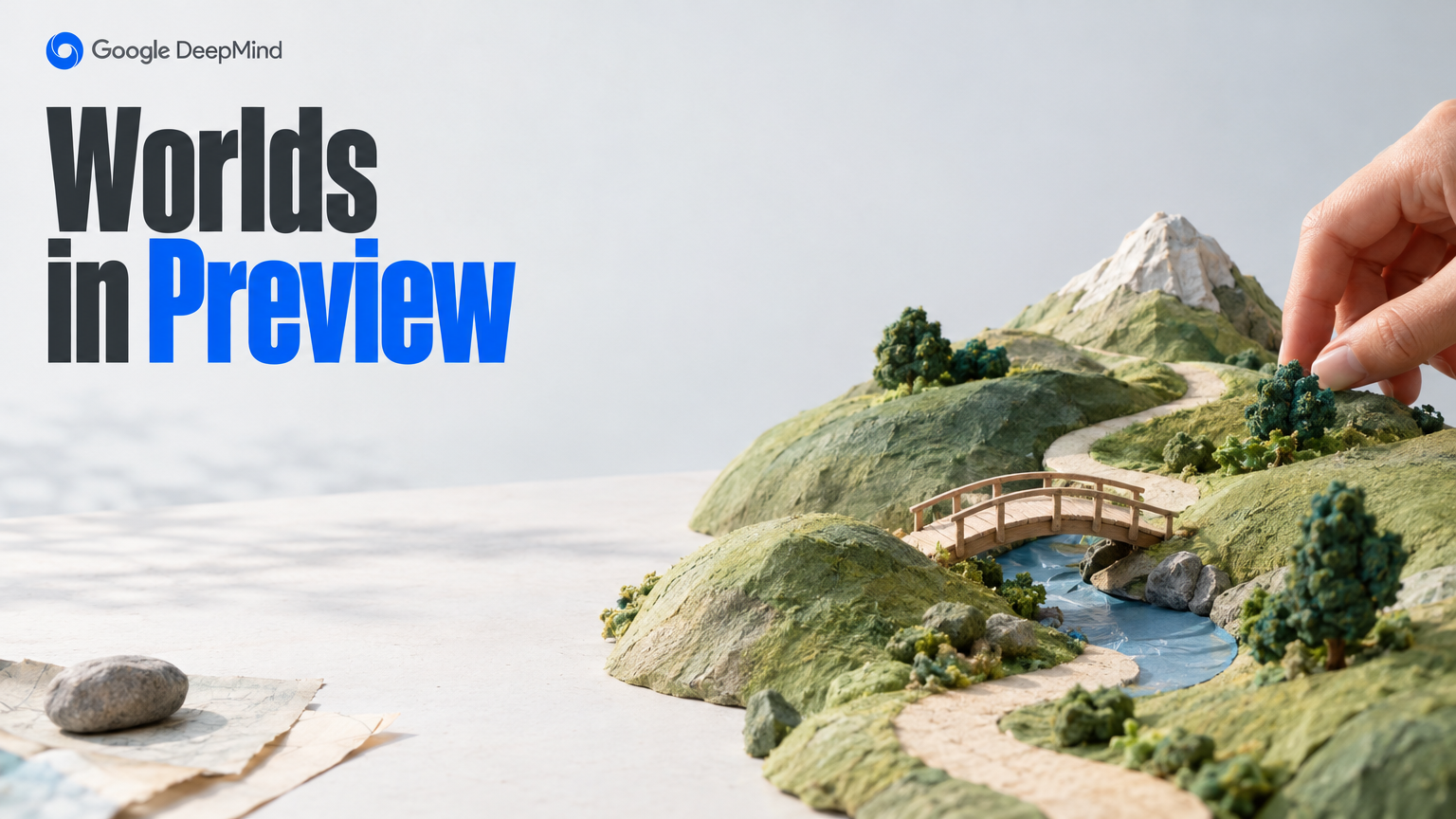
Google DeepMind has announced Genie 4, a model designed to generate interactive environments rather than answer questions like a conventional chatbot. The company says it is starting a research preview with trusted testers—not opening the system to the public. Its announcement describes real-time environment generation, native audio and text-driven changes, but those are company claims, not independently verified performance results. (Google DeepMind)
What’s changing
The central idea is that a user can interact with a generated world and influence it through text. DeepMind also describes audio as a native part of the experience. That makes Genie 4 a different kind of system from a chatbot that primarily responds with text: its stated purpose is to produce environments that can be explored and changed.
Those descriptions indicate the direction of the research, not a proven level of reliability. The announcement does not provide an independent evaluation or establish how well the model performs across different kinds of environments or extended use. Readers should treat the capabilities as an account from the company introducing the system, rather than as results confirmed by outside testing. (Google DeepMind)
Who can use it
For now, the announced preview is for trusted testers. DeepMind says it plans wider access through Project Genie for Google AI Ultra subscribers, and through the Gemini API and Google AI Studio for selected early-access partners. It has not given a specific date for those expansions or for general availability. (Google DeepMind)
That distinction matters: a planned route to some additional users is not the same as an open launch. People who are not in the trusted-tester group should not assume they can try Genie 4 now, or that a public release is imminent. Ars Technica likewise reported the announcement and noted that DeepMind had not supplied a timeline for broader rollout. (Ars Technica)
The open questions
DeepMind itself lists unresolved issues. Longer sessions can experience scene drift, while physical interactions, audio accuracy, legible text, spatial accuracy and consistency over time remain research problems. These caveats are important because an environment that looks convincing at first may not remain coherent as a person interacts with it for longer. The announcement does not quantify how often these issues arise or how they vary by task. (Google DeepMind)
The practical picture, then, is an early preview with an ambitious description and limited access—not a finished consumer product. The next meaningful signals will be whether planned access routes open, when they do, and what evidence emerges about how stable and useful the simulations are beyond the company’s own examples. For now, both the timeline and the system’s performance outside the preview remain uncertain.