Projects

Selected case studies demonstrating applied cloud architecture, backend platforms, payment systems, AI applications, and machine learning.

AI & LLM2026Featured

Trajectory AI Chatbot for Drone Flight Route Reservations

Conversational AI platform built for Trajectory's drone flight operations, helping operators query flight areas, routes, and reservation schedules through Rocket.Chat, Amazon Lex V2, and Go-based backend services.
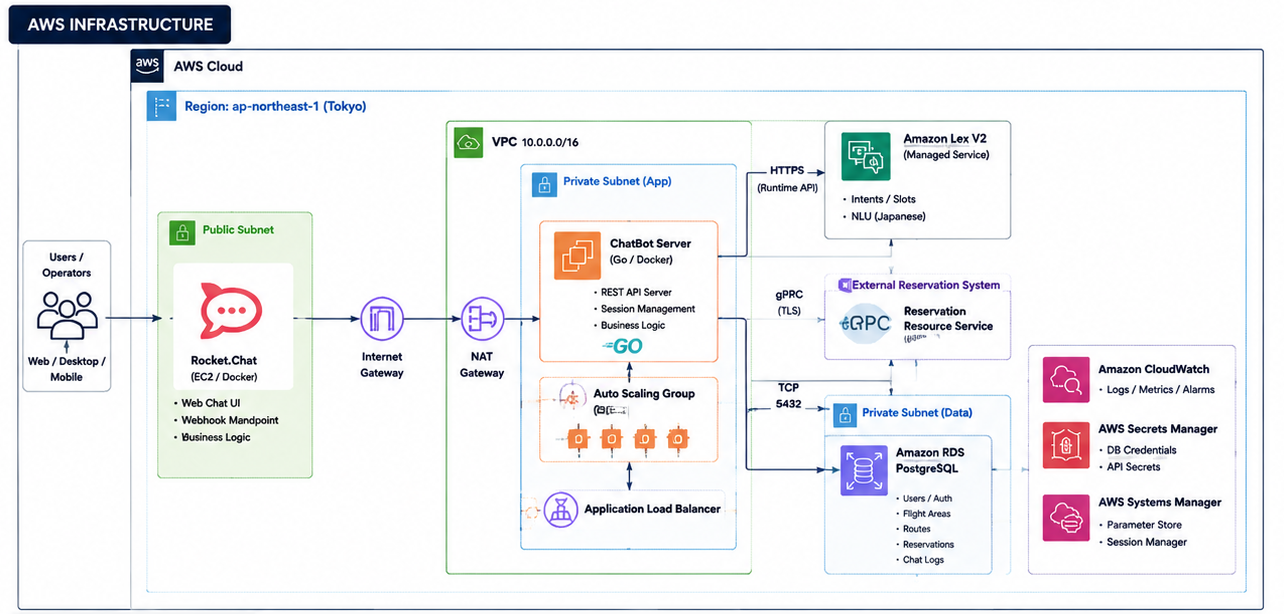
Trajectory AI Chatbot for Drone Flight Route Reservations research workflow

Problem

Users needed a reliable conversational way to retrieve drone flight route and reservation information across multiple systems. The solution also had to handle Japanese NLU constraints, authentication, time ranges, and service-to-service communication.

Solution

Built a Rocket.Chat-integrated chatbot server using Go and Gin with Amazon Lex V2 for intent and slot extraction. Connected it to a Go and Gin reservation resource server over gRPC and PostgreSQL/RDS, with MongoDB for chat data and Amazon S3 for attachments. Refined slot design with FreeFormInput, TimeEnd, session timeout, and error handling.

My Role

Cloud Architect & Senior Backend Engineer - designed service boundaries and integration flows, implemented chatbot and reservation services, integrated Amazon Lex and Rocket.Chat webhooks, refined Japanese conversation flows, supported authentication and deployment, and led end-to-end testing.

Outcome

Delivered ChatBot Server v0.4.2 with all eight functional test cases passing in the final report. Resolved route-list presentation, time-range queries, Japanese slot handling, admin-user filtering, and session-timeout issues.
Tech Stack

GoGinAmazon Lex V2Rocket.ChatgRPCPostgreSQLAmazon RDSMongoDBAmazon S3DockerAWS EC2AWS ALBRoute 53CloudWatch
AI & LLM2025

Kawaijuku Interactive AI Learning Platform PoC

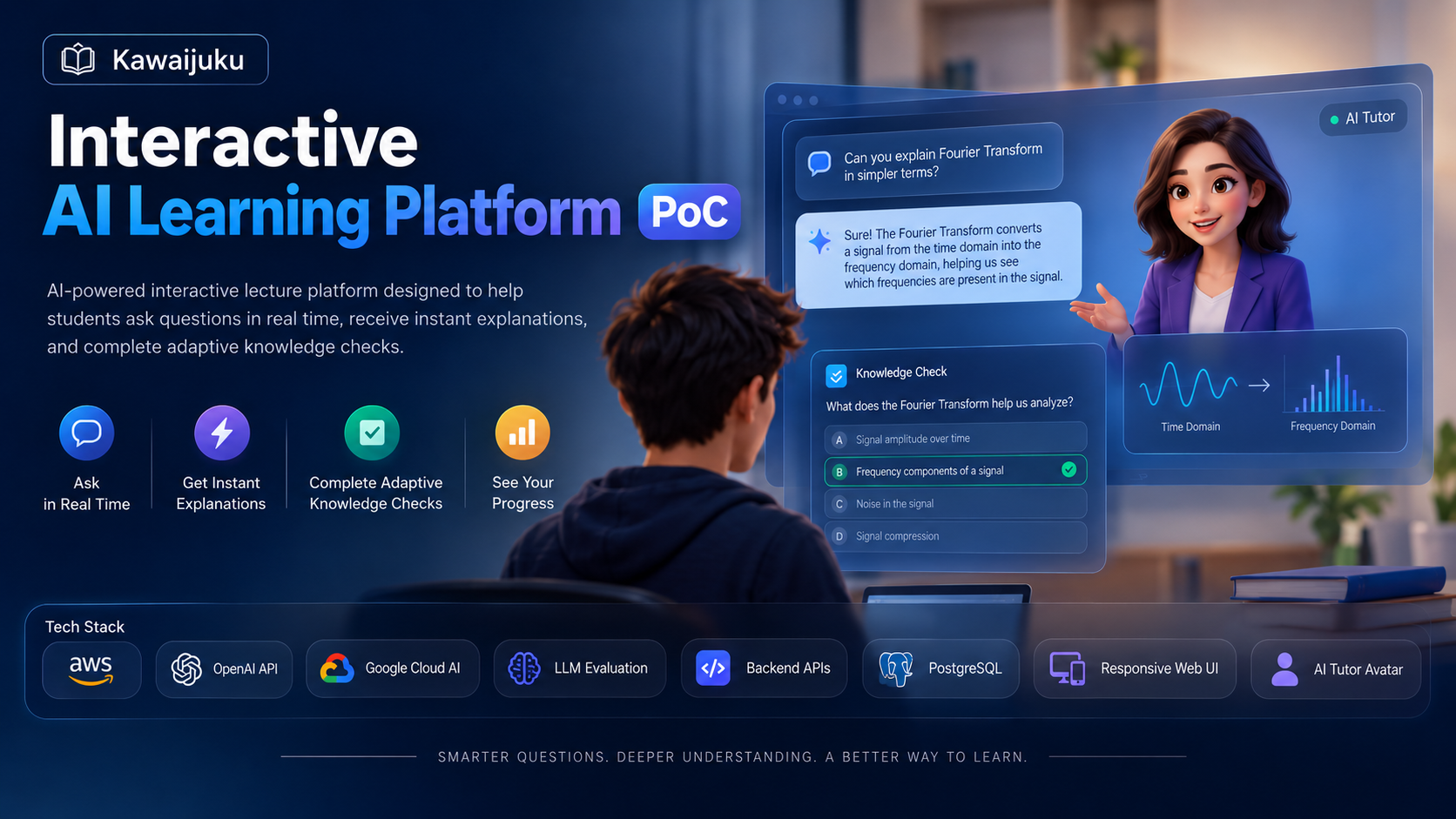
AI-powered interactive lecture platform designed to help students ask questions in real time, receive instant explanations, and complete adaptive knowledge checks.

Kawaijuku Interactive AI Learning Platform PoC research workflow

Problem

Traditional video-based learning can leave students waiting for clarification and makes it difficult to identify knowledge gaps. The PoC needed to combine real-time Q&A, progress visibility, and personalized follow-up within one learning experience.

Solution

Defined a phased PoC architecture combining lecture content processing, AI question answering, automatically generated or instructor-authored checkpoints, instant explanation generation, learning history, and an AI tutor avatar. The plan included model and API comparison, structured content ingestion, backend services, a responsive student UI, admin history management, and AWS deployment.

My Role

Cloud Architect & Senior Backend Engineer - contributed to the cloud and backend architecture, AI integration boundaries, data flows, API and error-handling approach, and operational plan for a secure, extensible education platform.

Outcome

Defined a 10-month, four-phase PoC plan covering AI model research, real-time Q&A, checkpoint generation, student UI, history and admin workflows, pilot evaluation, and tuning. Success criteria targeted at least 80% question-answering accuracy, responses within 10 seconds, and a smooth interactive learning experience, with production-scale delivery treated as a follow-on phase.

Tech Stack

AWSOpenAI APIGoogle Cloud AILLM EvaluationBackend APIsPostgreSQLResponsive Web UIAI Tutor Avatar
Machine Learning2021Featured

i-Nose C-19 ML Model

University news Research paper

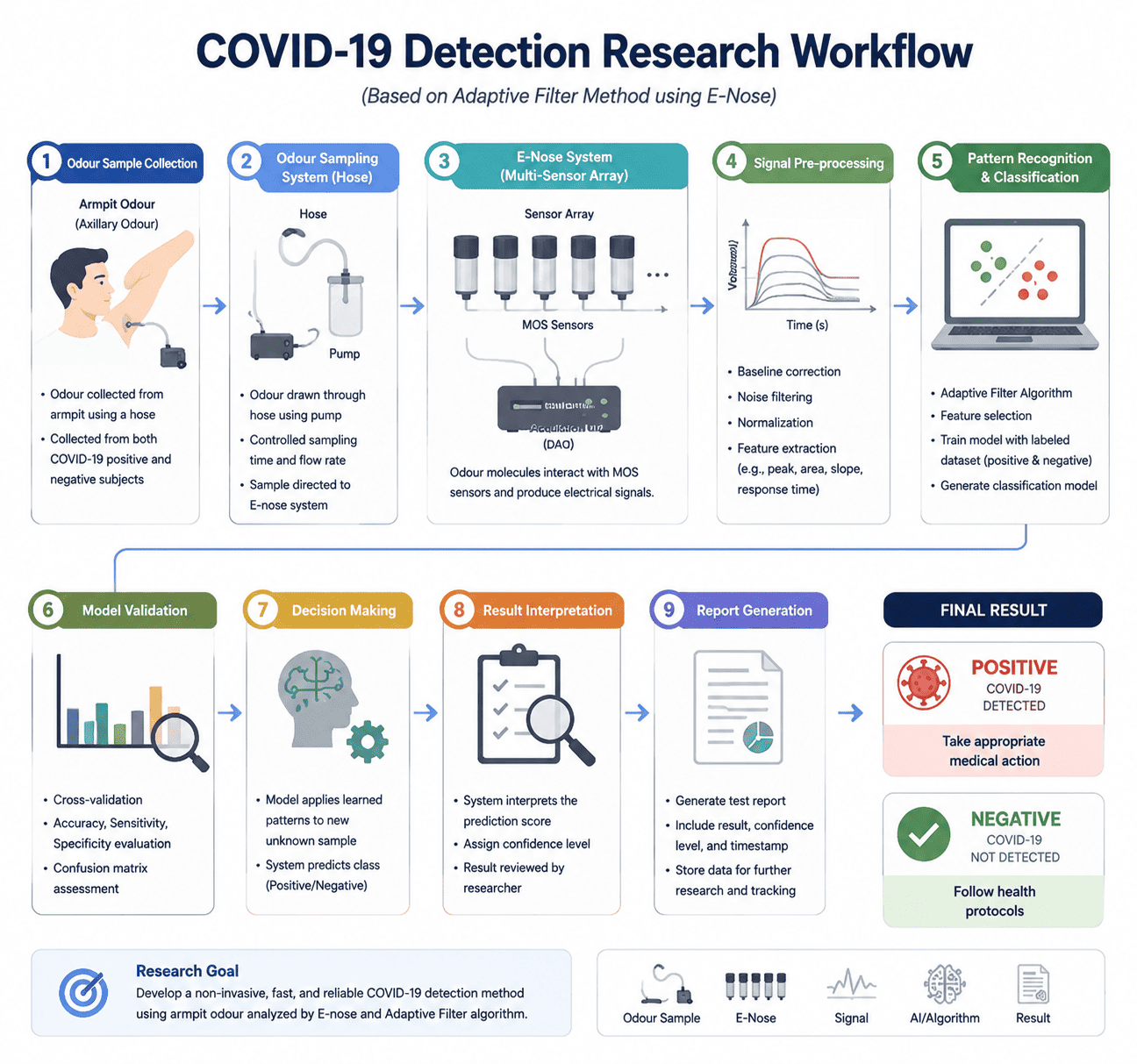
Deep learning model for non-invasive COVID-19 detection using electronic nose sensor arrays, deployed for edge inference on Raspberry Pi.

i-Nose C-19 ML Model research workflow

Problem

Electronic nose signals from underarm sweat can contain invalid or anomalous observations that reduce data quality and make downstream respiratory-infection screening less reliable.

Solution

Developed an adaptive filtering approach that combines a deep neural network with self-feature extraction to detect outliers in electronic-nose signals. Compared the method with SVM, Naive Bayes, k-NN, Random Forest, XGBoost, and Euclidean z-score baselines, with a focus on real-time use.

My Role

First author and Machine Learning Engineer - contributed to the signal-processing and machine-learning design, feature extraction, model training and evaluation, comparative analysis, and research publication.

Outcome

The adaptive DNN with self-feature extraction achieved 90.4% average balanced accuracy for outlier detection and outperformed the evaluated baseline methods. The approach was designed to support real-time electronic-nose filtering and improve downstream screening performance. Published in the peer-reviewed Elsevier journal Sensing and Bio-Sensing Research, Volume 36, Article 100492 (2022).

Tech Stack

PythonTensorFlowTFLiteNumPyscikit-learnRaspberry Pi