AI & LLM2026
SmartMatch OCR: AI Document Processing & Verified Data
A Node.js and Express document-intelligence API that turns scans and PDFs into structured data through configurable extraction, validation, human review, and finalized output.
The challenge
Reading characters from a document is not enough to make its contents safe for business systems. Scans, PDFs, and faxed documents contain ambiguous values, inconsistent formats, and incomplete information. Teams need evidence for extracted fields, clear validation rules, and a review boundary before data is released downstream.
Architecture & approach
Project date: April 2026.
From OCR text to business-ready data
SmartMatch OCR is a document-intelligence product built around a distinction: recognized text is an intermediate result, not automatically trusted business data. The product processes PDFs, scanned pages, images, and fax documents through extraction, validation, review, and finalization before downstream systems consume the result.
I built the API with Node.js and Express. The public OpenAPI 3.1 specification explains the processing contract; it does not disclose the underlying database or cloud infrastructure.
Versioned extraction requirements
Each project defines what to extract through a Target Profile. Profiles can describe fields such as dates, amounts, names, or document-specific values, along with validation and matching rules.
Publishing a profile creates an immutable version. Documents reference a fixed profile version during processing, and responses include project and profile-version identifiers. This makes an extraction traceable to the requirements used for that processing run rather than to a silently changing configuration.
A staged processing lifecycle
The documented workflow separates responsibilities into explicit stages:
- Upload: create a document container and add image pages or a PDF.
- Pre-check: assess input quality and whether required information can be located.
- AI processing: submit an asynchronous OCR/extraction job to the configured provider.
- Interpretation and validation: locate candidate values, normalize them, apply rules, and retain the source location needed for review.
- Review and approval: route uncertain items to a reviewer and a separate approver.
- Finalization: expose only confirmed data through the external-consumption endpoint.
The specification uses Google Document AI as an example external provider. That example is not a claim that it is the only deployed OCR engine.
Human review as an API boundary
The documented review flow prevents the same person from acting as both primary reviewer and secondary approver. Outstanding review items block finalization, and disagreements have an explicit error response.
Intermediate extraction and validation results are permission-gated. The /final endpoint represents the downstream business-data boundary; a document that is not finalized must not be treated as ready for an accounting, ordering, or management integration.
Retry safety, authorization, and auditability
The API contract documents bearer-token authentication using OIDC/JWT and role-based authorization. Mutating endpoints accept an Idempotency-Key so retries need not create duplicate work, particularly around asynchronous AI processing.
Provider failures, timeouts, invalid state transitions, and review conflicts are represented separately. Audit endpoints and configuration-version references support tracing how a document moved from upload to confirmed output.
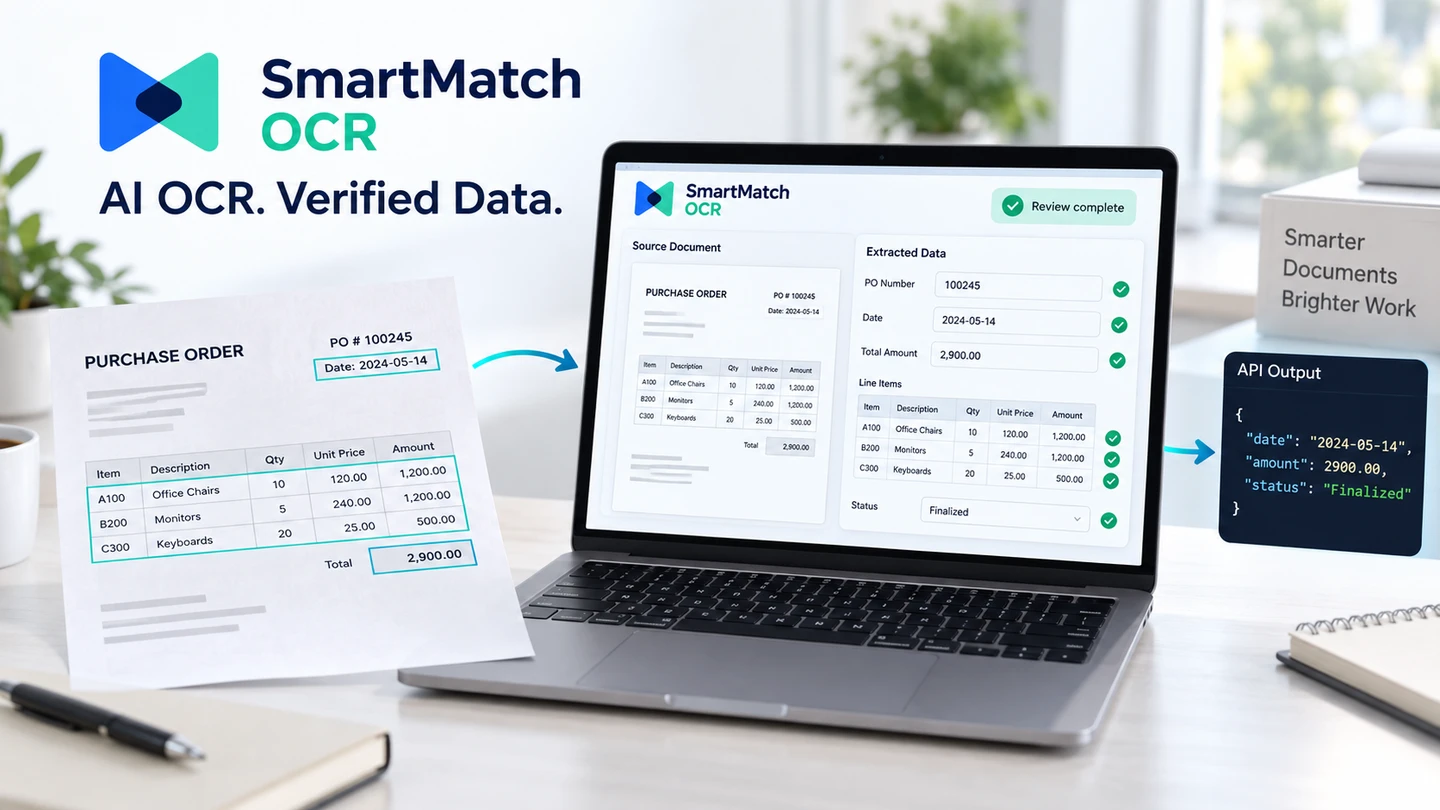
These are documented interface and workflow capabilities, not evidence of a measured availability target or accuracy benchmark. The generated cover illustrates the document-to-reviewed-data flow; the live site and API reference show the current product.
My contribution
Product Creator & Backend Engineer. Created SmartMatch OCR with a Node.js/Express API. Built an API-oriented document-processing product centered on structured extraction, validation, review, and a clear boundary between intermediate results and finalized business data.
Results & boundaries
Published a live product site and an OpenAPI reference for the document-processing lifecycle. The documented contract supports versioned extraction profiles, asynchronous jobs, validation, separate review and approval, audit history, and finalized output. The public site's adoption, accuracy, and speed figures are not presented here as independently verified engineering benchmarks.