AI news often jumps straight from a research result to a world-changing headline. AlphaFold 3 is worth understanding without making that jump.
What changed
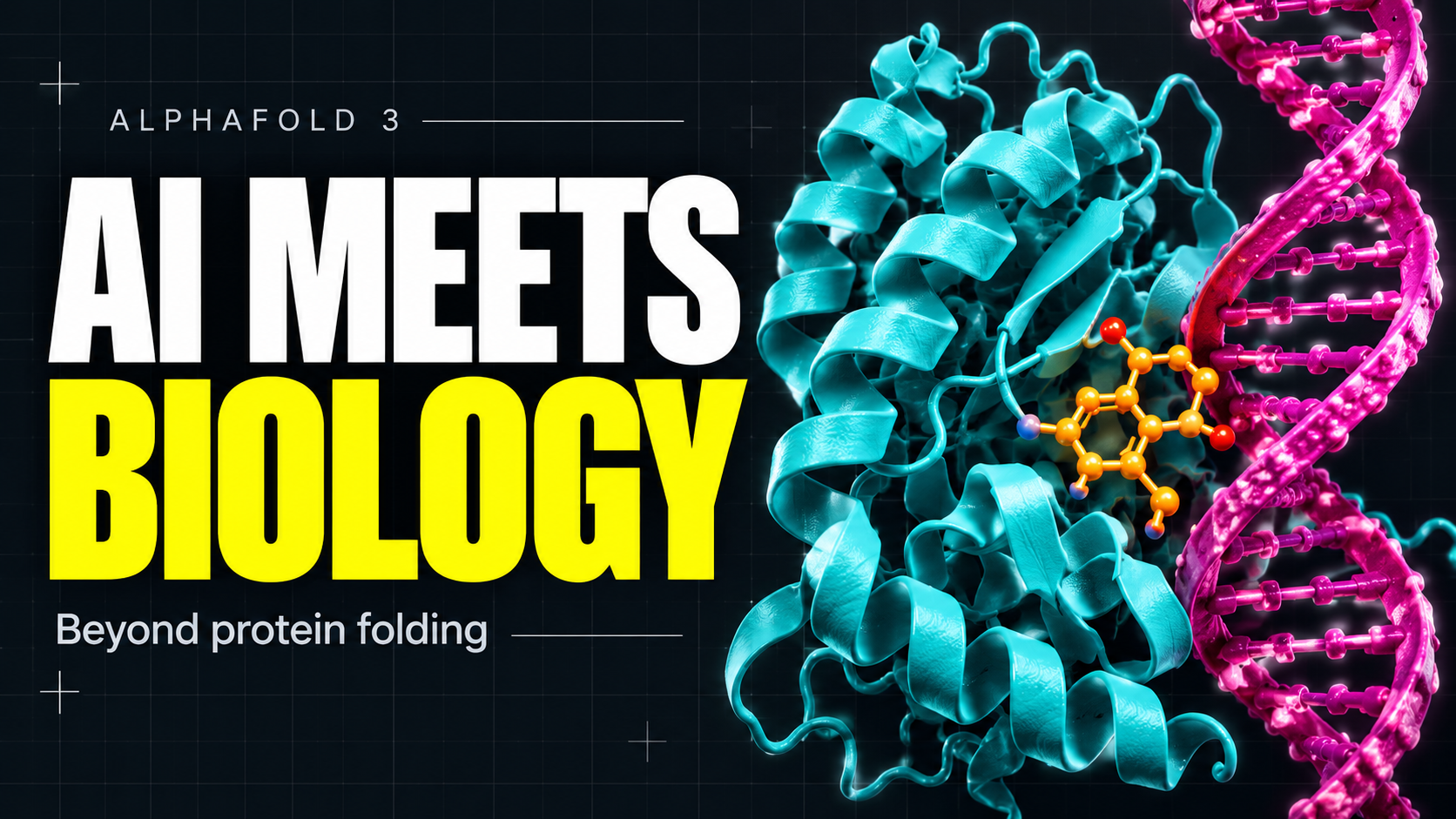
Google DeepMind and Isomorphic Labs introduced AlphaFold 3 on May 8, 2024. The model broadened structure prediction to interactions involving proteins, DNA, RNA, and other molecules, including ligands. The announcement described a diffusion-based approach and linked the work published in Nature. Its significance was the expanded scope of molecular modeling, not a general-purpose chatbot getting better at biology. The original research announcement provides the scientific context.
Prediction is a useful starting point
Imagine trying to understand whether several intricate pieces might fit together. A predicted structure can suggest where to look. It is not the same as observing those pieces interact under real experimental conditions.
That distinction matters when discussing scientific AI. A model can help prioritize a hypothesis while still leaving the central experimental question unanswered. Avoid reading a molecular prediction as proof of safety, clinical effectiveness, or a finished treatment.
A paper-reading checklist
When a research model makes an impressive claim, I recommend asking four questions:
- What exactly is being predicted?
- Which datasets and evaluation conditions support the result?
- Where does performance weaken or uncertainty increase?
- What independent experiment would validate the useful part of the prediction?
These questions apply beyond biology. A sensor classifier, forecasting system, or document extractor also needs a clearly defined target and evaluation setting. Being accurate on one benchmark does not establish reliability in every deployment.
Why this story belongs in an engineering journal
For software teams, the transferable lesson is about interfaces between predictions and decisions. Store provenance, preserve uncertainty, and make it possible to review the evidence behind a recommendation.
A scientific workflow should let people distinguish measured observations from model-generated hypotheses. That is a stronger design principle than presenting every AI output with the same confident visual treatment.
This article is a retrospective explanation of the research announcement, not medical advice or a report of a laboratory experiment I performed.