Your first apartment in Japan can come with an unexpected puzzle: a bottle, a cardboard box, an old charger, and four different pieces of advice about where they belong.
The surprising life hack is not memorizing "Japanese garbage rules." It is building a small system for your address, then letting that system answer the ordinary questions. One correct local guide beats a folder of contradictory travel videos.
Practical guide checked October 5, 2026. Yokohama and Shinjuku are examples, not nationwide instructions. Your municipality's current guidance and your building's arrangements take priority.
Why the internet keeps giving you different answers
A video may be accurate for the creator's city and still wrong for yours. Even a familiar-looking object can fall into a different category depending on local rules, its material, or its size.
Yokohama offers an English sorting guide and an item-search tool called Mictionary. The search page also notes that plastic-sorting procedures changed across its wards in April 2025. That is a good reason to use the current municipal page rather than an old screenshot saved by a previous tenant. Yokohama's English guide Mictionary and the plastic-rule update
The lesson is not that Yokohama's rules apply everywhere. It is that local information has a location and a version. Both matter.
You do not need to become an expert in waste management. You need to know where the authoritative answer lives and how to find it again.
Step one: make a home page for your home
Create a private note with your municipality's sorting guide, the collection schedule for your address, the building's collection-point instructions, and the contact you would ask when something is unclear.
Keep the links rather than only screenshots. Screenshots are useful offline, but they do not update themselves. Add a short "checked" date so your future self knows whether the information was saved last week or several years ago.
Ask the property manager to clarify the building-specific part. The municipal guide tells you how items are handled; the building instructions help you understand where and when residents should put them. Do not infer either from a bag that happens to be outside today.
This note is a suggested organization method, not a government form. Its value is reducing repeat searches. Once the correct links are in place, the task becomes much smaller.
Step two: sort at the moment you create the waste
A giant mixed bag creates tomorrow's problem. A few small collection spaces create today's decision.
Use whatever fits your home: boxes, reusable containers, or simple labeled areas. You do not need to buy a fashionable multi-bin station. The labels should match the categories in your local guide, not the categories in a product advertisement.
Place the setup where you actually finish unpacking or cooking. If every item must travel across the apartment to be sorted, the system is harder to maintain. Keep it accessible without blocking exits or making the space unsafe.
Separate the easy everyday items immediately. Put uncertain items aside for a lookup rather than letting one awkward object turn the whole bag into a guessing game. The temporary "check first" area is a research queue, not a new disposal category.
A bottle is a set of questions, not one universal answer
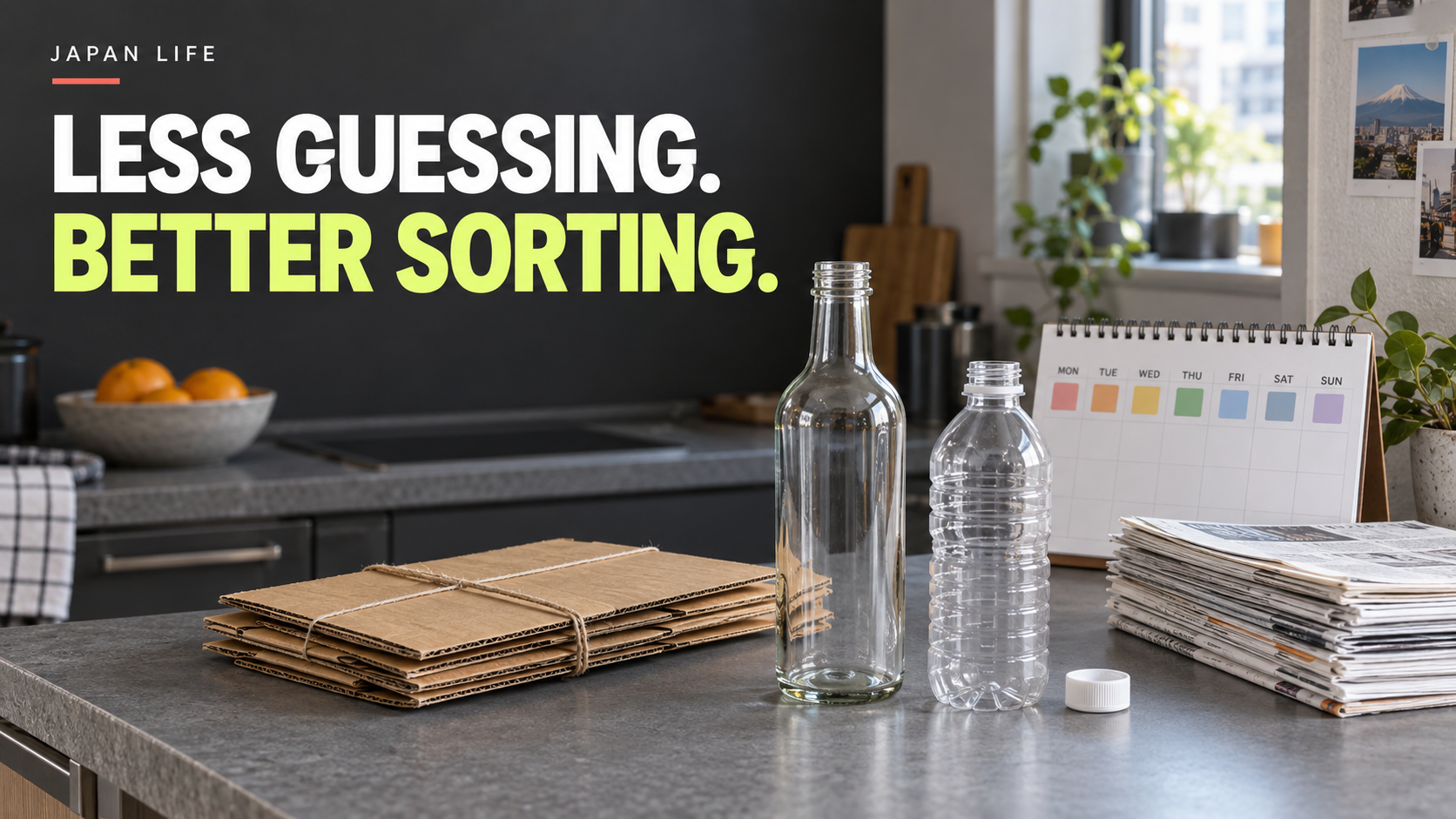
Consider an illustrative drinks bottle. You might need to check the container, cap, label, remaining contents, and required preparation. Those details depend on the applicable local instructions; this article deliberately does not prescribe one procedure for all of Japan.
The useful process is to look up the complete item once, then record the local answer in your household note. Next time, you can repeat the same verified routine.
Avoid turning preparation into unnecessary perfectionism. Follow what the municipality asks for rather than inventing extra steps from online comments. If the guide distinguishes dirty items from clean ones, read that distinction carefully.
When a package combines several materials, inspect what it actually contains. A recycling symbol can be a clue, but it does not replace the municipal collection rules. A quick lookup is better than a confident guess copied from another city.
Make the collection calendar boring on purpose
Set recurring reminders using the actual schedule for your location. Name each reminder with the category and collection point, not just "garbage day." Include special instructions if your official schedule gives them.
Check how holidays, year-end periods, and severe weather are handled locally. Do not assume your phone's ordinary weekly reminder accounts for service exceptions.
Here is an illustrative routine: the evening before collection, review the relevant container and prepare what is allowed; at the required time, put it at the correct collection point. Whether an evening preparation step is useful depends on the building's rules. It is not permission to leave bags outside whenever convenient.
The point is to move the thinking earlier. A calm check at home is easier than interpreting a detailed guide while rushing out of the door.
The awkward-item queue
Create a short list for items that need an individual answer: a worn-out appliance, a broken object, a large furniture piece, or an electronic accessory. Include a photo for your own reference and the item's approximate dimensions where relevant.
An item-search tool is useful because you can ask about the object instead of trying to translate an entire rulebook. Yokohama's Mictionary supports English item lookup. Shinjuku also publishes an item dictionary, illustrating how detailed a municipality's categories can be. Yokohama's item search Shinjuku's item dictionary
Do not interpret "not listed" as "put it in the nearest bag." Ask the municipal service or the appropriate local contact. The item might need a separate procedure rather than more creative sorting.
Batteries are a check-first item
A battery-powered object is a good reason to slow down. Find the current local instructions for the battery type and the device; do not treat every electronic item as ordinary household waste.
Shinjuku's current collection page, for example, has specific battery separation and terminal-insulation instructions. That is local guidance, not a national shortcut. Do not dismantle a device or handle a damaged battery based on a general blog. Ask the municipality or an appropriate collection service when safe disposal is unclear. Shinjuku's battery and recyclable collection guidance
For your household system, the actionable rule is simply "look this up before disposal." Put that reminder in the note where you will see it. A safe uncertainty is better than an unsafe certainty.
A large item needs a plan before moving day
Furniture is where an otherwise tidy system can fail. A small bin routine does not tell you what to do with a desk you cannot take to the next apartment.
Shinjuku describes a separate bulky-waste procedure, including booking through its reception service. Check your own municipality's definition, application process, fee arrangement, and collection instructions well before the move. Do not assume an item can be left beside the regular bags. Shinjuku: bulky-waste procedure
Make an inventory before the final packing weekend. For each item, decide whether to keep it, transfer it responsibly to someone who wants it, or arrange the appropriate disposal. Confirm the procedure rather than building your schedule around a guessed collection date.
This is also a purchasing question. Before buying a very large item for a temporary stay, consider how you will eventually move or dispose of it. The checkout price is only one part of the decision.
An illustrative first-week setup
Imagine moving into a small apartment with a flatmate. On the first day, you collect the official links and confirm the building's collection point. On the second, you label the everyday sorting spaces. On the third, you set reminders from the actual schedule.
After the first week, compare your setup with the waste you really produce. Maybe the paper container is too small and the uncertain-item area keeps filling up. Adjust the storage, not the rules.
Agree who checks unusual items and who takes out which collection. A shared household does not need a complicated rota, but it does need one understood answer. Otherwise, everyone assumes someone else read the instructions.
The scenario is illustrative. It is not a report of the author's personal apartment experience, and it does not imply that all buildings operate alike.
Four shortcuts that are not shortcuts
Copying the neighbors: you may not know what is in their bag or whether it was correctly prepared.
Copying your old city: a move can change the rules even when the objects in your kitchen stay exactly the same.
Using translation as the final authority: a translated summary is useful, but unclear distinctions should lead you back to the official instructions or a question to the responsible service.
Leaving the difficult item for moving day: that is usually the moment when you have the least time to research an unfamiliar procedure.
None of these failures means you are bad at living in Japan. They mean the process relied on memory or assumption where a local reference would have helped.
Keep the system small enough to use
Review the note when you move, when the municipality announces a change, or when you encounter an unfamiliar item. Otherwise, let the routine stay ordinary.
Do not collect every disposal article on the internet. Keep the official local guide, the address-specific schedule, the building instructions, and your short list of resolved questions. Remove outdated shortcuts instead of leaving several conflicting versions side by side.
A useful home system should reduce decisions. If maintaining it takes more effort than the task itself, simplify it. One understandable label beats a beautiful container nobody remembers how to use.
The fridge-note version
My address. My current guide. My collection schedule. Check unusual items first.
That is the entire idea. Japan's household sorting stops being a daily guessing game when you stop asking for one universal rule and start keeping the correct local answer within reach.
Sources
- Yokohama: English sorting guide (checked 2026-10-05)
- Yokohama: Mictionary item search (checked 2026-10-05)
- Shinjuku: Item-sorting dictionary (checked 2026-10-05)
- Shinjuku: Batteries and recyclable collection (checked 2026-10-05)
- Shinjuku: Bulky-waste procedure (checked 2026-10-05)