A cafe is easy to find. A place where you can actually follow a thought is a different question.
Japan's public libraries are worth exploring when you want to read, research, or spend some time with a subject without the background pressure of another order. The useful trick is to choose a library for what it provides, not to assume every library is a free coworking space.
Some focus on local lending. Others are reference libraries where the materials stay inside. That distinction changes how you plan a visit, which documents you need, and whether you can take a book home.
Start with the kind of visit you want
Choose a purpose before choosing a building. Are you looking for a book to borrow, a source for a research question, or time to read material from the collection?
These are different trips. Borrowing might require a registration process tied to where you live, work, or study. A reference visit might give you access to a collection without giving you permission to borrow it. A quiet room might still have rules about personal work, calls, food, or the use of particular seats.
Make a short list of what you want to leave with: the name of a book, a better understanding of a question, or notes from a source. You do not need to turn a Saturday visit into a research grant application. One clear intention is enough to make the first hour more rewarding.
For example, you might want to understand the history of a neighborhood you have started visiting. A relevant map, local-history book, or reference conversation can offer a different experience from scrolling restaurant recommendations. This is a suggested approach, not a claim that every branch has that collection.
A concrete reference-library example
Tokyo Metropolitan Central Library's visitor information describes a reference library in Minami-Azabu. Visitors obtain a reader card on entry, without an identity document being required for that entry card. Its materials are for use inside the library, not home borrowing. The page also identifies laptop-use areas, Wi-Fi information, and available facilities.
The important distinction is that an entry card is not the same as a local lending card. Likewise, permission to use a laptop in designated areas does not automatically mean every activity is allowed everywhere.
Read the current visitor guide before you go. Save the address, opening information, and closure calendar. A beautiful room is not useful if you discover at its entrance that today is a closed day.
For a first visit, make the plan small: arrive, understand the layout, find one useful source, and leave with a reason to return. You can build a more ambitious routine once the basic process feels familiar.
Borrowing needs its own check
If you want books at home, start with the relevant local library's registration rules. A library card is not a single nationwide pass with identical eligibility.
Shinjuku City Library's first-time guide, for example, explains eligibility and the evidence required for registration. It distinguishes people living in Tokyo from people outside Tokyo who work or study in Shinjuku. The guide specifies address verification and, where relevant, work or study verification.
That example is useful because it shows why an old post saying "just bring ID" can be incomplete. Check the official page for your own situation, including what constitutes acceptable evidence, before making a special trip.
You can prepare a small checklist with the exact library name, the registration page, required documents, and the purpose of the visit. Keep document images private. Do not upload identity evidence to a third-party site simply because it offers a convenient-looking registration shortcut.
Search the catalogue before you travel
A title is a better starting point than a hopeful walk through every shelf. Use the library's own catalogue and note the information that helps you find an item: title, author, location, availability, and any access conditions shown.
If you are not searching for a known book, write down a few keywords. Start broad, then narrow them. A question such as "How did this neighborhood change?" can become searches for the neighborhood name, urban history, maps, or a particular period.
Do not expect the first result to answer the whole question. Think of catalogue searching as building a small path through the collection. One useful book can point you toward another topic or source.
Before you travel for a specific item, check whether it is actually available to you at that location. A catalogue record is not a promise that the book will be on the nearest shelf when you arrive. Follow the library's guidance for reservations or enquiries if those apply.
A two-hour visit that does not feel like homework
Here is an illustrative visit plan you can adapt to the rules of the library you choose.
Start with orientation. Find the help desk, the relevant collection, and the permitted reading area. Put your phone on an appropriate quiet setting. Notice where personal items belong so they do not block another reader.
Pick one main source. Instead of collecting a tower of books immediately, skim the contents and introduction of one relevant item. Decide whether it is worth sustained attention. Your goal is understanding, not a photograph of an impressive stack.
Write a small question. What does this source help you understand? What is still unclear? A question gives your reading direction and stops note-taking from becoming random copying.
Take useful notes. Record enough bibliographic detail to find the source again. Separate a quotation from your own summary and interpretation. If you use a short quotation later, credit it accurately rather than presenting someone else's language as yours.
Finish with the next step. Before you leave, decide whether to return, investigate another source, or simply keep the understanding you gained. A productive visit can end with one clear idea, not necessarily a complete project.
These time blocks are a personal planning example. They are not seat-reservation periods or an official promise about facilities.
Ask a better reference question
Library staff can be easier to approach when you explain what you have already tried. Instead of asking for "everything about Japan," describe a narrower subject and the kind of material you are looking for.
For example: "I am trying to find introductory material about this area's history. I checked these catalogue terms, but I am not sure which collection is relevant." That gives the person a useful starting point without expecting them to do your entire project.
Check the library's reference-service scope and available languages. A reference service is not necessarily translation, tutoring, or unlimited personal research. Being specific about your need makes the conversation more respectful and more likely to help.
If the library cannot provide what you want, ask which official resource or institution might be more relevant. A redirected search is still progress.
Keep the quiet useful for everyone
Read the rules for the area you use. Designated laptop seats, group rooms, food areas, and phone-call locations can have different conditions. Do not infer permission from what another visitor happens to be doing.
The Tokyo Metropolitan Central Library's English guide provides a concrete example of differentiated facilities and access procedures. The National Diet Library's Tokyo guide is another reminder that reading-room purposes and laptop areas are institution-specific.
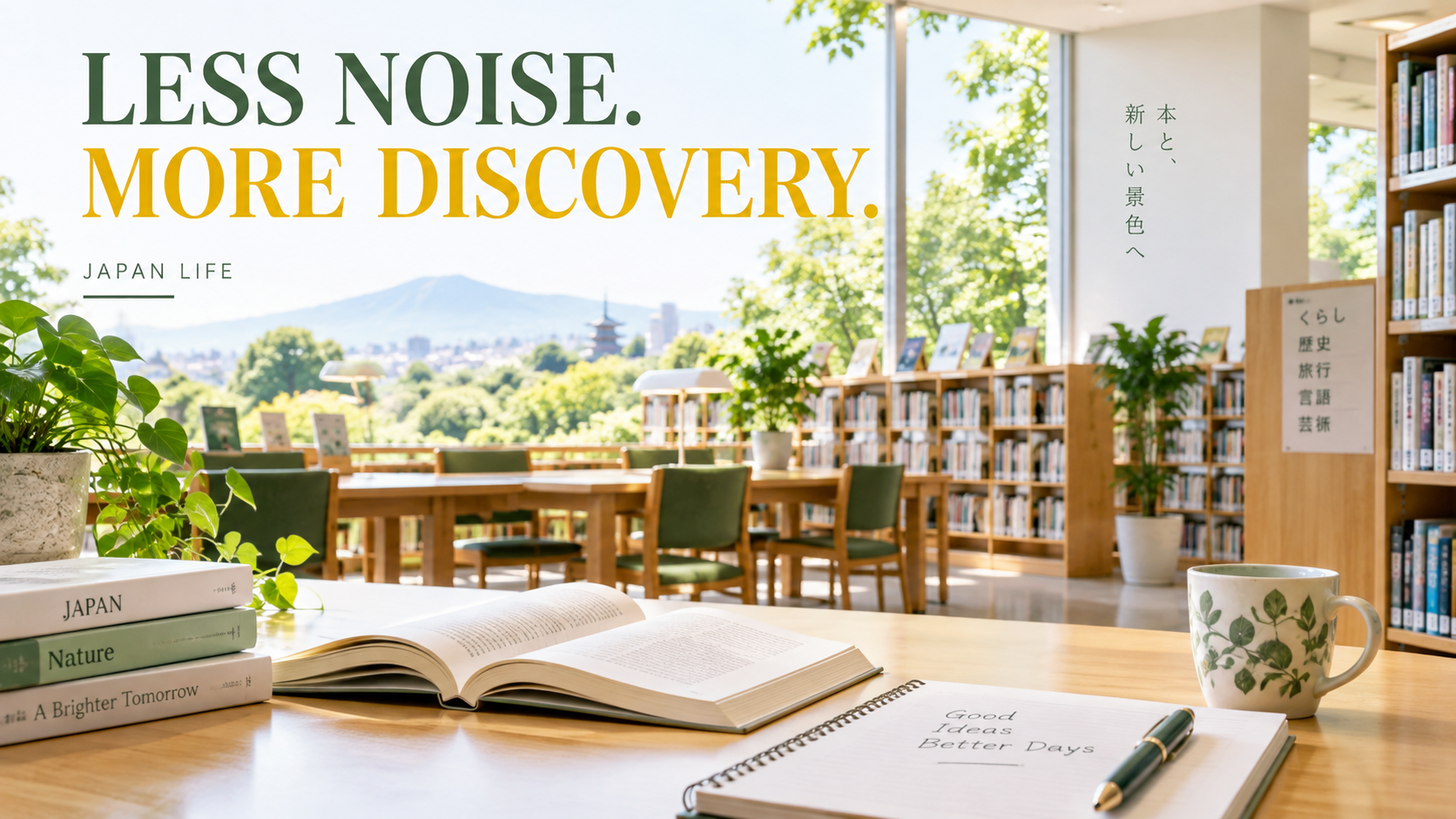
For a work meeting, a place specifically allowing calls is a more suitable choice than improvising in a reading room. For food or a drink, use the permitted area. The cover artwork's relaxed setting is illustrative; it does not grant permission to bring a mug to a library desk.
Being considerate is not an extra task that ruins the visit. It is part of what makes a shared quiet space valuable.
Make the second visit easier
After leaving, save three things: the correct official page, one useful catalogue keyword, and one note about the process you learned. Avoid collecting ten library apps or bookmarking every possible branch before you have used one.
If borrowing is available to you, keep track of the actual loan conditions and return date. If you used a reference collection, keep enough source details for a future visit. These are different habits, and neither needs to be complicated.
The life hack is not "never pay for a cafe again." Sometimes a cafe is exactly what you want. It is knowing that reading and research have another setting, with a different pace and a different kind of discovery.
You might go in looking for a book. The better result is leaving with a question you genuinely want to follow.
Sources
- Tokyo Metropolitan Central Library: Visitor information (checked 2026-10-05)
- Shinjuku City Library: First-time registration (checked 2026-10-05)
- Tokyo Metropolitan Central Library: English guide (checked 2026-10-05)
- National Diet Library: Tokyo user guide (checked 2026-10-05)