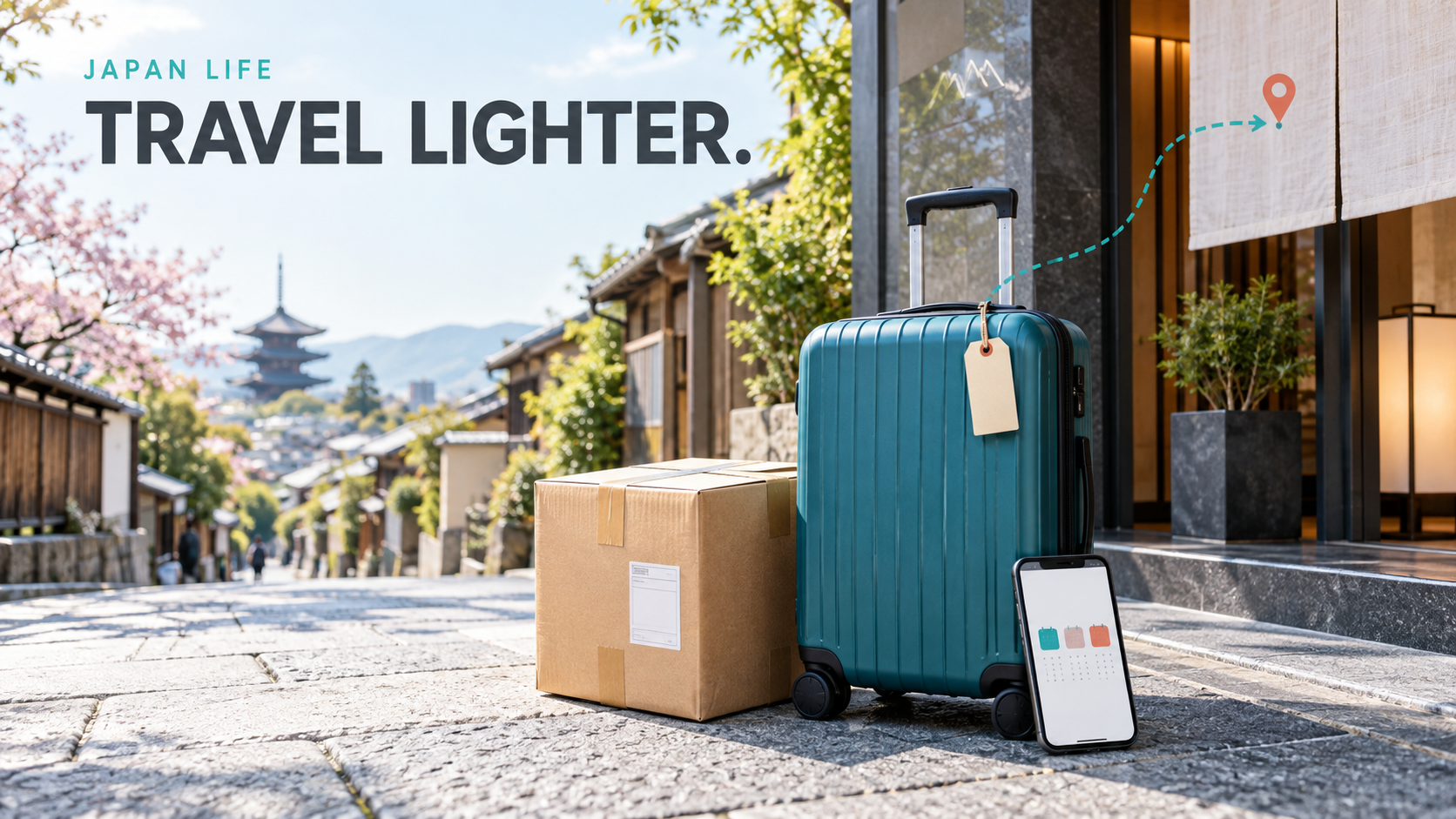
There are two very different parcel problems in Japan: you missed a delivery at home, or you are about to drag a suitcase through an entire travel day. They feel unrelated, but the useful habit is the same: plan where the item should be, when it should arrive, and who can receive it.
You do not need a collection of delivery tricks. You need the correct carrier, a realistic date, and a record of the request.
Practical guide checked October 5, 2026. Delivery availability, fees, acceptance rules, and cutoffs vary. Confirm the details with the actual carrier and receiving accommodation.
First, do not throw away the little slip
An attempted-delivery notice is not just a piece of paper telling you something went wrong. It identifies the carrier and the parcel. Keep it until the item is safely received.
Yamato's official guidance tells recipients to check the notice and request redelivery through its supported process. Japan Post provides a separate online redelivery form using the tracking or notification number. These are not interchangeable systems. Yamato: missed delivery Japan Post: redelivery form
Photograph the notice for your own records if useful. Do not post it publicly: it may contain an address, a tracking reference, or other information you would not want strangers using.
The low-effort improvement is to bookmark the carrier's official page now. When you are tired after work, a saved link is easier to trust than the first result returned by a hurried search.
A delivery notification is not automatically trustworthy
If a message asks you to pay or enter personal details, pause and compare it with the parcel you actually expect. Open the carrier's official site yourself instead of treating every text-message link as legitimate.
This is a general security habit, not a claim that a particular message is fraudulent. The important distinction is between recognizing a company name and verifying the destination you are about to use.
A real problem should still be traceable through the official carrier channel. Keep the notice or tracking number, and contact support if the information does not line up. A rushed payment is a poor substitute for checking.
Pick a time you can really keep
Choose the offered redelivery date and time window around your actual schedule, not the version of your schedule where nothing runs late. Save the confirmation and add a reminder if the wait might slip your mind.
Japan Post's linked web form is for redelivery to the address on the notice; it directs other receiving arrangements to its inquiry process. Do not assume changing the delivery location is just another field in the same form. Japan Post's receiving-location instructions
If the available window conflicts with work, check the carrier's current pickup or alternative-receiving options. Eligibility differs, so do not generalize one successful arrangement to all parcel types.
The win is a successful handover, not finding the cleverest workaround.
Now the travel hack: let the suitcase take a different route
Luggage forwarding can be useful when the bag's journey does not need to match yours. Yamato's TA-Q-BIN service accepts eligible parcels and supports options such as date selection and sending through supported counters. Its official page explains size rules and notes that counter services and deadlines can differ. Yamato: TA-Q-BIN
That creates a planning option, not an automatic recommendation. Compare the fee and effort with carrying the bag, storing it temporarily, or simplifying your route.
If you have a short, straightforward transfer, forwarding may be unnecessary. If you want to explore between hotels without a large case, it may be worth investigating. Your comfort, schedule, and budget decide whether the trade-off makes sense.
Ask the receiving hotel before asking the courier
Before sending anything, confirm that the destination accommodation can receive it and how the parcel should be addressed. Ask about the arrival date, reservation name, payment arrangement, and any restrictions.
These are suggested planning questions, not a universal hotel policy. An unattended apartment and a staffed hotel are different receiving situations. A booking confirmation alone is not permission to send luggage there.
Keep the accommodation's answer somewhere easy to retrieve. Then compare it with the carrier's current service options. Both sides need to agree: a courier accepting an item does not prove the destination can hold it for you.
Pack the bag you will actually need tomorrow
Here is an illustrative two-night split: your large case goes toward the next confirmed accommodation, while a small bag stays with you for the intervening day. The example is a packing strategy, not a delivery-time promise.
Before handing over the case, separate the items you cannot comfortably be without: essential medicines, travel documents, valuables, charging equipment, and a change of clothes. Check carrier restrictions rather than assuming every item can be shipped.
Do this before sealing or handing over the luggage. Reopening a bag at a busy counter is possible in some situations, but avoiding the scramble is easier.
The best packing question is not "Will it probably arrive?" It is "If it does not arrive when I expect, can I still get through the day?"
Airports have their own clock
Airport luggage delivery is a separate service with an earlier deadline. Yamato says bags generally need to be dropped off two days before departure, or three days in some areas; the specific sending deadline depends on the counter. Check the airport and counter details directly, not a general next-day-delivery assumption. Yamato: Airport TA-Q-BIN
Work backward from the flight, not forward from the moment you feel like packing. Confirm where you collect the bag, the counter's hours, and the required arrival date. Keep the receipt and tracking details accessible without the shipped case.
If the timing is unclear, carrying the luggage yourself may be the less stressful choice. A life hack should reduce the number of fragile assumptions in your day, not add another one.
The complete handover note
Keep a private note containing the carrier, tracking number, destination, expected date, and receiving contact. Add the booking name if the accommodation requested it. Record what remains in your day bag.
The note can be plain text. You do not need a new productivity app. The advantage is having the same facts ready for the courier, the hotel, and yourself instead of reconstructing them from scattered screenshots.
Once the item is received, check it and close the loop. Remove sensitive information from shared devices or shared notes when it is no longer needed.
The unexpectedly useful result
This is not really a hack about parcels. It is about designing a day with fewer things to carry mentally and physically.
At home: correct carrier, workable slot, saved confirmation. On a trip: confirmed recipient, verified deadline, essential items kept with you. If those pieces are clear, the convenience comes from the plan, not from luck.
Sources
- Yamato Transport: Missed delivery (checked 2026-10-05)
- Japan Post: Online redelivery (checked 2026-10-05)
- Yamato Transport: TA-Q-BIN (checked 2026-10-05)
- Yamato Transport: Airport TA-Q-BIN (checked 2026-10-05)