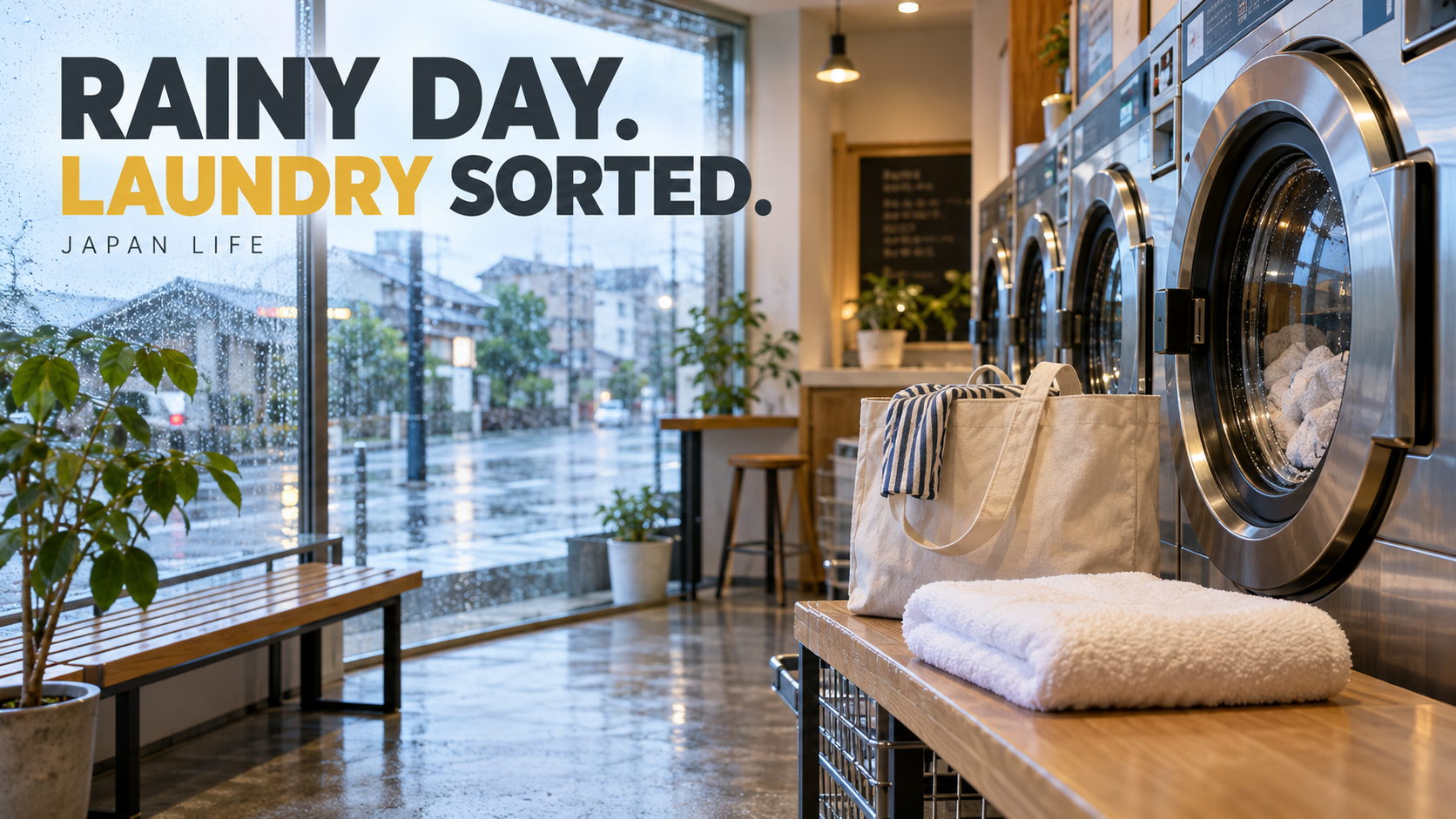
Rain outside. A small apartment inside. Three shirts left, and none of them quite dry.
This is a good moment for a laundry plan, not a heroic attempt to hang another towel above every available doorway. A nearby coin laundry can help, but choosing the right cycle matters more than choosing the biggest machine.
Your first decision is about the clothes
Separate the things that need washing from the things that only need suitable drying. Then look at the care labels before you leave home.
Washing and tumble drying are different permissions. A garment that can go in a washing machine is not automatically suitable for a heated dryer. The Consumer Affairs Agency's laundry-symbol guide provides official references for interpreting the labels. Its current care-label explanation also explains the relevant washing-label framework.
Do not turn an expensive coat into a learning experiment. Set aside delicate, unknown, or specialist items for an appropriate service. The purpose of this errand is to make tomorrow easier, not to win an argument with a fabric label.
Pick a store you can realistically revisit
Search near the place where you will spend the waiting time. A slightly closer store is not necessarily better if its machines do not match your load or you cannot return comfortably in the rain.
WASHHOUSE's store search is one operator-specific starting point. Check the selected branch, not only the brand homepage. Services and equipment can differ. A washer, a dryer, and a combined wash-and-dry machine solve different problems.
Imagine a small load of ordinary clothing whose labels permit the relevant process. You might choose to stay nearby with a book rather than start a complicated extra errand. That is a suggested routine, not a guarantee about seating, staffing, or waiting rules at a particular store.
A quick machine check
| Before you start | What you are trying to avoid |
|---|---|
| Match the machine to the allowed process | Paying for the wrong kind of cycle |
| Read the load limit | Cramming in more than the machine permits |
| Check detergent instructions | Adding detergent to a process that already supplies it |
| Confirm the accepted payment | Discovering the app or coin requirement too late |
| Note the machine number and end time | Forgetting which machine you used |
WASHHOUSE's service information says charges and timings vary by location and equipment. Treat the display on your chosen machine as the current reference rather than borrowing a fixed duration from someone else's guide.
If instructions are unclear, use the store's official support contact before paying. Keep the machine number handy so you can describe the problem accurately.
Make the waiting time genuinely useful
Set a return reminder based on the machine's displayed cycle, with a little travel margin if you are leaving the premises. Also check whether leaving is allowed and what the store expects when a cycle ends.
Choose one low-friction task: read a chapter, plan tomorrow's groceries, or review your calendar. This is not the moment to cross town because an app says a train connection is technically possible.
Bring a clean bag for the finished load. Keep the bag that carried damp or dirty clothing separate if necessary. A lightweight reusable tote is easier to manage than balancing a pile of clean shirts under an umbrella.
When the cycle finishes, collect your things promptly according to the store's rules. Do not move another person's belongings on your own initiative; ask the operator how it handles occupied machines.
Drying is a check, not a guess
Follow the clothing label and machine instructions for the permitted process. At the end, check the load rather than assuming that a finished timer means every thick seam is ready to pack away.
If further drying is appropriate, follow the machine's options. If an item is not suitable for that dryer, use a permitted alternative. Do not increase heat simply because you are impatient.
Back home, put away the dry items and give anything still damp a suitable place to finish drying. Check care instructions again for unfamiliar materials. A wet bundle forgotten in a bag has not really solved the laundry problem.
Build a rainy-week version of your routine
You do not need a major household system. Keep a small laundry bag, a saved link to a relevant store, and enough time in the week to deal with a load before you run out of clothes.
Notice what repeatedly causes friction. Is it bedding that exceeds your home setup? A lack of suitable drying space? Waiting until your final clean shirt? The answer tells you when the outside laundry is worth the trip.
The best rainy-day hack is boring in the nicest way: understand the label, choose the correct machine, and come back when the clothes are ready. Tomorrow starts with one less problem.
Sources
- Consumer Affairs Agency: Laundry symbols (checked 2026-10-05)
- Consumer Affairs Agency: Care-label explanation (checked 2026-10-05)
- WASHHOUSE: Store search (checked 2026-10-05)
- WASHHOUSE: Services and equipment guidance (checked 2026-10-05)